


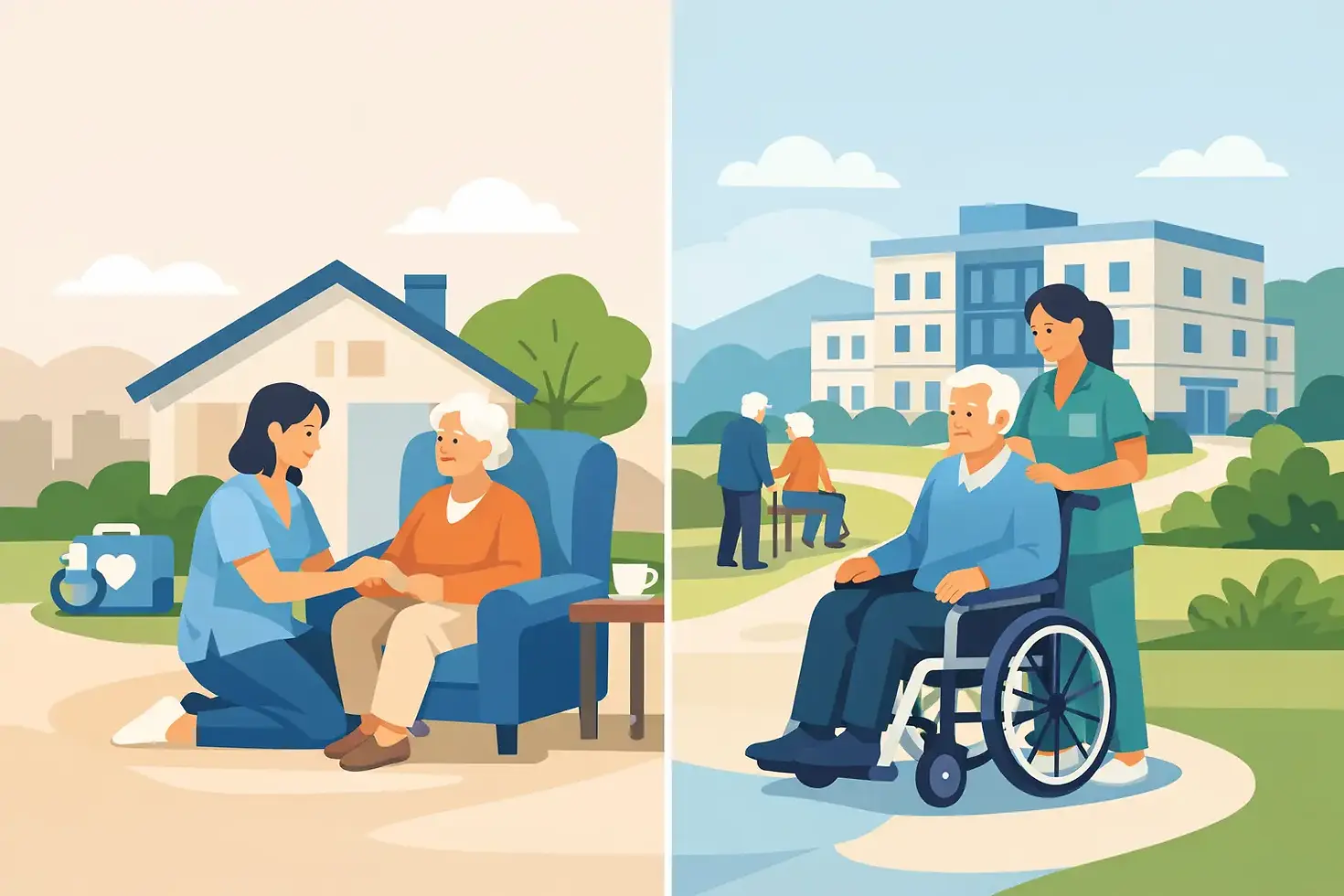
Care at Home or Care Home?
A fall in the kitchen, missed medication, or growing confusion around daily routines can change a family conversation very quickly. When that happens, one question often comes to the surface: is it better to choose care at home or care home support? There is no single right answer for every older person, because the best care is the care that fits someone’s health, wishes, routines and sense of security.
For many families, the decision carries practical pressure and emotional weight in equal measure. You may be trying to keep a parent safe while also respecting their independence. You may be balancing work, children and caring responsibilities of your own. What helps most is stepping back from the fear of getting it wrong and looking carefully at what each option can realistically provide.
Care at home or care home: what is the difference?
Care at home means support is provided in the person’s own home. That can range from a short daily visit to help with washing and dressing, through to more regular support with meals, medication, mobility, companionship and wellbeing. In some cases, care can be arranged several times a day, depending on need.
A care home, by contrast, involves moving into a residential setting where care staff are on site. Some homes provide personal care only, while others also offer nursing care for people with more complex medical needs. Meals, activities and day-to-day support are organised within that setting rather than around the person’s own home life.
At the heart of the decision is this difference: one option brings support into a familiar environment, while the other involves moving into an environment designed around care.
When care at home may be the better fit
Home care is often the preferred option when an older person wants to remain in familiar surroundings and can do so safely with the right support in place. That familiarity matters more than many people realise. A known layout, treasured belongings, a regular chair by the window, and neighbours who still say hello can all support confidence and emotional wellbeing.
For people living with dementia, remaining at home can sometimes reduce distress because routines and surroundings are already known to them. For others, the benefit is more about autonomy. They can decide when to get up, what to eat, what to wear and how to spend the day, without having to fit into the timetable of a communal setting.
Home care can also work well when support needs are mainly practical. This might include help with personal care, meal preparation, medication prompts, mobility around the house, shopping, light household tasks and companionship. If family members are involved too, domiciliary care can ease the strain and create a more sustainable arrangement.
There is also a dignity aspect that families often feel strongly about. Receiving one-to-one support at home can feel more personal, more respectful and less disruptive than moving away from everything familiar.
When a care home may be the better fit
There are situations where a care home is the safer or more realistic choice. If someone needs round-the-clock supervision, has very advanced dementia, or faces repeated risks that cannot be managed well at home, residential care may offer greater stability.
Care homes can also be appropriate for people who are very isolated and may benefit from a more communal environment. Some residents enjoy shared meals, organised activities and the reassurance that staff are present throughout the day and night.
In cases where care needs have become highly complex, families may find that trying to coordinate support at home is no longer practical. That does not mean home care has failed. It simply means needs have changed. Good care decisions are not about proving a point. They are about matching support to the reality of the moment.
The emotional side of care at home or care home decisions
This decision is rarely just about services. It is also about identity, family roles and loss. An older person may hear the suggestion of a care home and feel that their independence is being taken away. A son or daughter may feel guilty for even raising the subject. Another family member may be exhausted and frightened, but unsure how to admit they cannot keep doing everything alone.
That is why honest conversation matters. It helps to focus not on labels, but on daily life. Is your loved one eating properly? Are they safe using the bathroom alone? Are they taking medication correctly? Are they lonely? Are nights becoming difficult? Questions like these often lead to clearer answers than asking, in the abstract, whether somebody is “ready” for care.
Where possible, the older person should be involved from the start. Even if they need support with decision-making, their wishes, habits and concerns should still guide the conversation. Person-centred care begins before any service starts.
Looking at safety, independence and quality of life
Families sometimes assume that safety and independence sit at opposite ends of a scale. In reality, the right support can protect both. Home care, when tailored properly, can reduce risks without removing choice. A person may still live in their own home, use their own bathroom, sleep in their own bed and keep their own routines, while receiving help in the areas where they are no longer safe alone.
That said, independence does not mean coping without assistance. It means having as much control over life as possible. For one person, that may mean staying at home with visits each day. For another, it may mean moving into a care home where they no longer struggle through basic tasks in isolation.
Quality of life is often the deciding factor. If staying at home means constant anxiety, missed meals and family burnout, it may no longer be the kinder option. If moving into residential care would cause confusion, distress and a deep sense of dislocation, then support at home may preserve wellbeing more effectively.
Cost matters, but value matters too
Cost is understandably part of the discussion, and families often compare care at home or care home fees straight away. The difficulty is that prices vary widely depending on the level of support needed, where you live, and whether nursing care is required.
Home care may seem more affordable when someone needs a small number of visits each week. As needs increase, costs can rise. A care home may appear expensive, but it includes accommodation, staffing and daily living support within one overall arrangement. Neither option is automatically cheaper in every case.
What matters is looking beyond the headline figure. Consider what is actually included, how flexible the support is, and whether it meets both current and likely future needs. A lower-cost option is not better value if it leaves major gaps in safety or wellbeing.
Questions that help families decide
If you are weighing up care at home or care home support, it helps to look at ordinary life rather than worst-case fears. Can your loved one manage safely between visits? Are they comfortable having carers in the home? Is the property suitable, or would stairs and access create ongoing problems? How much support is the family providing already, and is that arrangement sustainable?
It is also worth asking what matters most to the person receiving care. Some people will accept quite a lot of practical support if it allows them to remain at home. Others feel anxious alone and would prefer the reassurance of a staffed setting. There is no virtue in choosing the option that looks best on paper if it does not suit the individual.
A local, personalised care assessment can make these decisions much clearer. In areas such as Chichester and the wider West Sussex community, families often find that professional advice helps them separate urgent needs from understandable worry.
Why many families start with home care
Where it is safe to do so, many families choose to begin with home care because it is less disruptive and easier to adapt over time. Support can start gently, perhaps with help in the morning or with meals and medication, then increase if needs change. That flexibility can be especially valuable after a hospital stay or during a period of decline that is still unfolding.
For a provider such as Avoston, the aim is not simply to complete tasks. It is to support daily life in a way that protects dignity and helps people remain themselves. Good home care should feel reassuring, not intrusive. It should strengthen confidence, reduce family stress and make ordinary days more manageable.
Sometimes home care remains the right long-term answer. Sometimes it becomes a stepping stone to residential care later on. Either path can be thoughtful, compassionate and right for the person involved.
The most helpful starting point is often the simplest one: look closely at the life your loved one has now, the risks they are facing, and the kind of support that would help them feel safest, most comfortable and most like themselves. From there, the next step is usually easier to see.


Comments